As the demands on manufacturing tools grow in complexity and precision, the materials used to…
Tooling 5.0: How Industry 4.0 is Transforming the Die & Mould Landscape
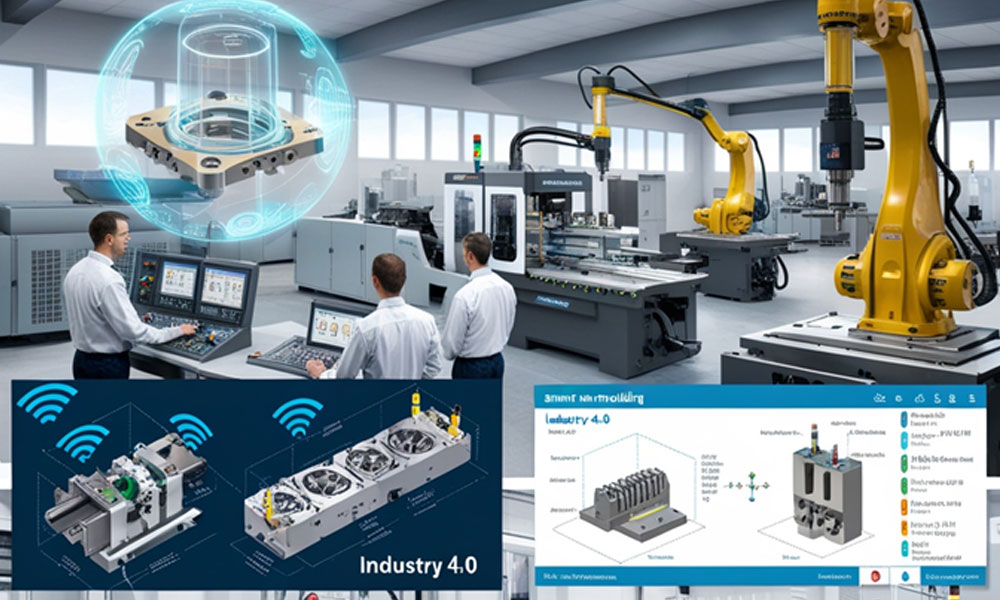
The die and mould industry, once considered the traditional backbone of manufacturing, is undergoing a massive digital shift. As Industry 4.0 technologies such as the Internet of Things (IoT), artificial intelligence (AI), machine learning, and cyber-physical systems become mainstream, the tooling sector is evolving into what many are now calling Tooling 5.0. With this transition, toolrooms are transforming into smart, connected ecosystems capable of predictive performance, real-time decision-making, and unprecedented levels of precision and efficiency.
From digital twins simulating die performance before production to IoT-enabled toolrooms that optimize workflows autonomously, the integration of Industry 4.0 technologies is fundamentally redefining how dies and moulds are designed, manufactured, monitored, and maintained.
What is Tooling 5.0?
Tooling 5.0 refers to the intelligent, data-driven era of die and mould manufacturing powered by the core principles of Industry 4.0. This paradigm goes beyond automation and CNC precision—it creates a fully integrated, digital-first tooling environment where machines, systems, and people collaborate in real time.
This transformation is driven by four major pillars:
- Digital Twins
- IoT-enabled Toolrooms
- Predictive Maintenance
- Smart Moulding Systems
- Digital Twins: A New Age in Tool Design
A digital twin is a virtual replica of a physical asset—in this case, a die or mould—that mirrors its design, behavior, and real-time performance. These digital models allow toolmakers to simulate every aspect of tool function before a single chip is cut.
By using CAD/CAM software integrated with finite element analysis (FEA), fluid flow simulation, and thermal modeling, digital twins help engineers:
- Optimize tool design for strength and efficiency
- Predict wear patterns and deformation
- Eliminate trial-and-error in prototyping
- Reduce material usage and tool development time
This not only improves first-time-right tool manufacturing but also speeds up time to market and ensures cost-effective operations. Companies like Siemens and Dassault Systèmes are at the forefront of bringing digital twin technology into Indian toolrooms.
- IoT-Enabled Toolrooms: Smarter and More Connected
The adoption of IoT devices across toolrooms is redefining production workflows. Machines equipped with sensors can now collect, share, and analyze data at every stage of the tooling lifecycle. These connected environments bring the following benefits:
- Real-time performance monitoring: Sensors track spindle speed, temperature, vibration, and pressure during machining, allowing fine-tuned process control.
- Tool life optimization: IoT helps predict tool wear and alerts operators before failure occurs, ensuring consistent part quality.
- Energy efficiency: Smart systems adjust machine usage based on demand and availability, reducing idle energy consumption.
- Inventory management: RFID and barcode tracking automate raw material and tool component inventory, reducing downtime caused by stock-outs.
In India, several advanced toolrooms, especially in the automotive and aerospace clusters of Pune, Chennai, and Bengaluru, are adopting IoT-based solutions to enhance competitiveness.
- Predictive Maintenance: Eliminating Downtime Before It Happens
Traditional maintenance practices in die and mould shops follow a reactive or scheduled approach. However, with predictive maintenance—a hallmark of Tooling 5.0—tools and machines can self-diagnose and predict faults before they occur.
Using a combination of machine learning algorithms and historical data, predictive maintenance systems can:
- Detect anomalies in machine behavior
- Schedule maintenance only when necessary
- Avoid unplanned stoppages and extend machine life
- Reduce spare parts inventory by forecasting needs accurately
For example, sensors embedded in injection moulds can monitor cycle time, cooling efficiency, and surface pressure. When deviations from optimal performance are detected, alerts are generated to guide maintenance teams. This proactive approach is reducing tool failure rates by up to 30% in some advanced toolrooms.
- Smart Moulding Systems: Automation Meets Intelligence
In the moulding phase, smart systems are transforming traditional injection moulding into an intelligent process that adapts in real-time. These systems integrate moulding machines with control software that can:
- Adjust injection parameters dynamically based on part geometry
- Monitor mould temperature, pressure, and fill time with extreme precision
- Ensure part consistency and eliminate defects
- Reduce scrap rates and improve sustainability
AI-powered moulding machines are capable of learning from every shot and adjusting parameters for the next cycle. They can identify warping, shrinkage, and surface defects using integrated vision systems and make corrections without human intervention. Smart moulding is especially critical in high-volume sectors like packaging, medical devices, and electronics.
Industry Applications and Success Stories
Tooling 5.0 is already finding traction across several industries:
- Automotive: Companies are using digital twins to simulate stamping dies for electric vehicle (EV) components, ensuring lightweighting and crash safety.
- Aerospace: Precision in complex geometries is achieved with 5-axis CNC machines integrated with IoT feedback loops.
- Consumer Electronics: Predictive mould maintenance ensures zero-defect parts for mobile and wearable devices.
- Medical Devices: Smart moulds with micro-cooling and digital quality checks are producing flawless parts with tight tolerances.
Challenges and the Way Forward
While the benefits of Tooling 5.0 are clear, adoption is not without hurdles:
- High initial investment: Smart sensors, simulation software, and connected systems can be costly, especially for MSMEs.
- Skill gap: Digital transformation requires a tech-savvy workforce trained in software, data analytics, and mechatronics.
- Cybersecurity: As toolrooms become connected, they also become vulnerable to cyber threats, necessitating robust data protection.
However, these challenges are being addressed through government support schemes, upskilling initiatives by TAGMA and NTTF, and increased access to cloud-based technologies that reduce capital burden.
Tooling 5.0 is not a distant future—it is unfolding today. By embracing Industry 4.0 technologies like digital twins, IoT, predictive maintenance, and smart moulding, Indian die and mould manufacturers can leapfrog into a new era of intelligent, resilient, and globally competitive manufacturing.
As the world demands faster, smarter, and more sustainable production, those who adopt Tooling 5.0 will shape the future of manufacturing—not just follow it.
Related Posts